Cornering: The Counterintuitive Truth Nobody Tells New Riders
May 22, 2026
Most riders learn to corner the way a child learns to swim — by falling in until something works. They mash the bars, hope for the best, and gradually stop white-knuckling.
There's a faster path. And it starts by understanding the single technique that 80% of new riders get wrong: where you look.
The eye-line problem
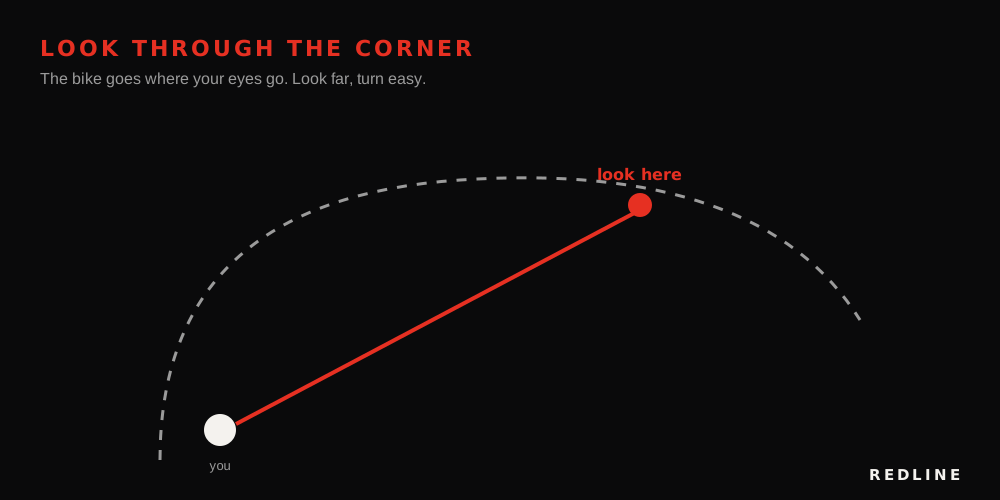
In a car, you look slightly ahead of the hood. In a motorcycle, that habit will put you in a guardrail.
A motorcycle goes exactly where you look. Not approximately. Exactly. If you stare at the gravel on the inside of the corner, you will ride into the gravel. If you stare at the apex you want to hit, you will hit it. This isn't mystical — it's how your inner ear and steering muscles coordinate. Your bike follows your gaze before your conscious brain catches up.
The rule:
Look as far through the corner as you can possibly see — and as soon as you can see further, look further.
The mistake new riders make is "checking" the road right in front of the bike "just to be safe". Every time your eyes drop to 10 meters ahead, your bike's lean angle stops scaling smoothly and you find yourself running wide.
This is the single most expensive mistake to fix because every rider you know is also doing it. There's nobody on your normal ride to copy. You have to consciously override the habit.
Counter-steering: the part that sounds wrong
This is the technique that breaks most people's brains the first time they read it:
To turn left, push the left handlebar.
That's it. That's the whole technique. The bars do not turn the way you think they do above ~10 km/h. They counter-steer. Push the left grip forward, the bike leans left, the bike turns left. Push the right grip forward, the bike turns right.
Try this right now on a stationary bike: lift the front wheel slightly off the ground and turn the bars. Notice that turning the bars left tilts the front wheel right. At speed, this rotation pushes the contact patch to the outside, the bike falls inward, and you turn.
Why does this matter? Because under stress, untrained riders try to "steer" the bars like a car steering wheel. They twist the bar left to turn left. The bike either does nothing (at speed it ignores you) or worse — the bike briefly turns the wrong direction before falling into the corner, and now you've used up a half-second you didn't have.
The drill, every ride for a month, on a straight quiet road:
- Two fingers light on each grip
- Push the left grip forward — feel the bike drift left
- Push the right grip forward — feel the bike drift right
- Notice you're doing nothing else. Just pushing forward.
Once this becomes muscle memory, you'll find yourself making smaller, calmer inputs in corners. The bike does what you ask immediately instead of fighting you.
Three more techniques that change everything
Once eye-line and counter-steering are dialed in, there are three more techniques that compound them. We cover each in the full guide:
-
Body position — what to do with your hips, your inside knee, and your shoulders. (Hint: it's not the dramatic hanging-off you see on track riders. For street, it's much subtler — and gets you 80% of the benefit at 0% of the risk.)
-
Trail braking — the technique that lets you brake into the corner, not before it. Once you understand this, late-apex cornering becomes intuitive instead of terrifying.
-
Throttle control in the corner — the rule of "always neutral or rolling on, never off" and why violating it is what causes 70% of single-bike crashes in corners.
What "advanced" actually means
Most riders think "advanced cornering" means dragging knee on a track. It doesn't.
Advanced cornering means: every corner feels the same regardless of speed, lean angle, surface, weather, or whether there's a deer in the road. The technique is so practiced that the corner itself becomes the only variable — your inputs are automatic.
That takes deliberate practice. Not just "riding more". Deliberate practice means picking one technique, drilling it in isolation for a week, then layering the next one in.
The advanced cornering manual is the one we'd wish we had when we started — the techniques in the order they should be learned, with the drills that build them, and the failure modes to watch for in yourself.
— REDLINE